


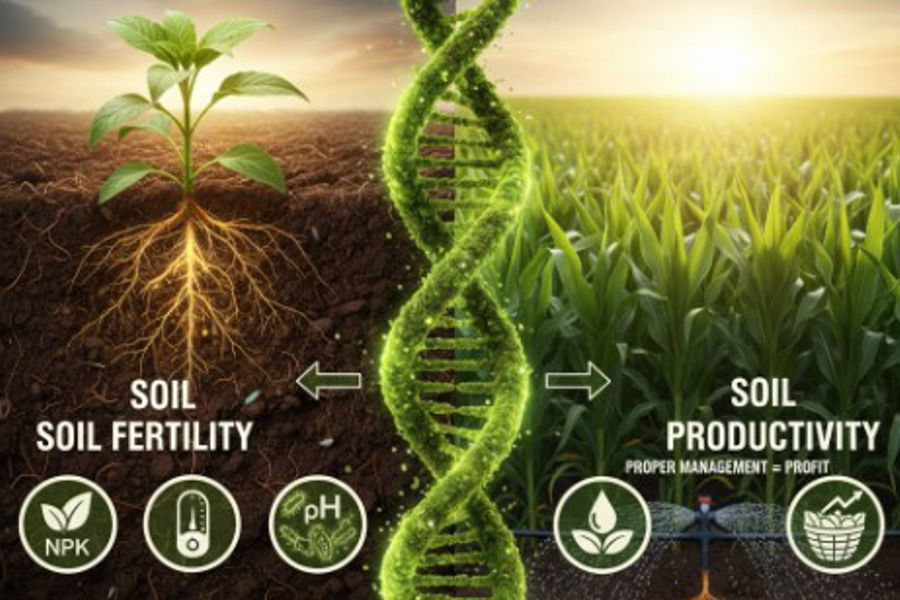
Understanding Soil Fertility vs Productivity for Profitable Farming
Farmers often say their soil is good or their soil does not give enough yield. However, to truly evaluate soil quality, two important scientific concepts must be understood: soil fertility and soil productivity. These two are not the same, and understanding the difference is essential for profitable farming.
What is Soil Fertility
Soil fertility refers to the availability of essential plant nutrients such as nitrogen, phosphorus, potassium, secondary nutrients, and micronutrients. Soil fertility is strongly influenced by organic carbon, soil pH, and microbial activity. It indicates the soil’s capacity to supply nutrients to crops.
What is Soil Productivity
Soil productivity refers to the actual yield or output obtained from the field. It depends on water holding capacity, drainage, climate, farming practices, technology, and crop management. Therefore, good fertility alone does not guarantee good yield.
Difference Between Fertility and Productivity
-
Fertility = Nutrient availability
-
Productivity = Actual crop yield
Every fertile soil may not be highly productive, and every productive soil may not always be extremely fertile. A well-known example is Israel, where sandy soil still gives high yields due to advanced water and crop management.
How to Improve Soil Fertility and Productivity
-
Apply organic manure, compost and farmyard manure
-
Follow crop rotation practices
-
Use fertilizers based on soil testing
-
Prevent soil erosion
-
Improve irrigation and water management
Conclusion
Soil is not just a physical medium; it is a living biological system. Higher yields come from a combination of fertile soil and proper management. Understand the soil, protect the soil, and make farming truly profitable.

