


Source–Sink Theory: Why Do Fruits Remain Small ?
Many farmers face a common problem. Crops appear healthy and vigorous. Leaves are green and well developed, flowering is satisfactory, yet fruits remain small, light in weight, or poor in taste. This situation often leads to confusion and economic loss.
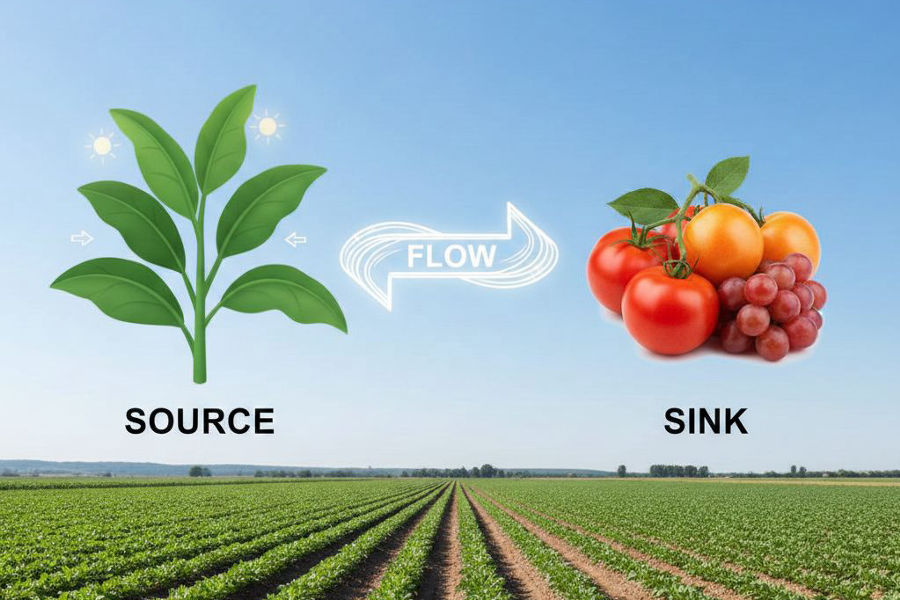
The real reason behind this issue is a fundamental plant physiological concept known as the Source–Sink Theory, also referred to as the Food Production–Utilization Theory.
Understanding this theory is essential for improving fruit size, quality, yield, and market value.
What Is “Source” in Plants?
In plant physiology, “Source” refers to the parts of the plant that produce food. Leaves and green stems act as sources. Through photosynthesis, leaves manufacture carbohydrates, sugars, energy, and amino acids, which are vital for plant growth and fruit development.
What Is “Sink” in Plants?
“Sink” refers to the plant parts that consume or store the food produced by the source. Fruits, pods, seeds, roots, and growing buds function as sinks. Strong sink activity is necessary for proper fruit growth and development.
Where Does the Problem Begin?
Problems arise when the source is strong but the sink is weak. In such cases, food production is adequate, but the utilization of that food by fruits is insufficient. As a result, fruits fail to develop fully and remain small.
Major Reasons for Weak Sink Strength
Several factors disturb the source–sink balance. These include deficiency of phosphorus and potassium, low levels of boron, zinc, and calcium, and excessive nitrogen that promotes vegetative growth at the cost of fruit development. Environmental stresses such as drought, high temperature, pest infestation, and disease pressure also weaken sink strength. When the plant’s transport system (phloem) is impaired, sugars remain trapped in leaves and stems instead of reaching fruits.
What Smart Farmers Focus On
Successful farmers do not rely solely on fertilizer application. They focus on maintaining a proper source–sink balance. Boron and phosphorus are supplied during flowering to support reproductive growth. Potassium and calcium are applied after fruit setting to improve fruit size and strength. Zinc and amino acids are used to enhance nutrient movement, and spray water pH is maintained at an appropriate level for better absorption.
Results of Correct Source–Sink Management
Proper management leads to improved fruit size and uniformity, better color and taste, higher market value, and stronger fruits suitable for premium and export markets. Yield improvement of 20 to 30 percent is commonly observed when source–sink balance is maintained.
Conclusion
Fruits do not remain small due to lack of potential. They remain small because the source–sink connection is weak or broken. Once this balance is corrected, crops express their full genetic potential and deliver superior yield and quality.

