


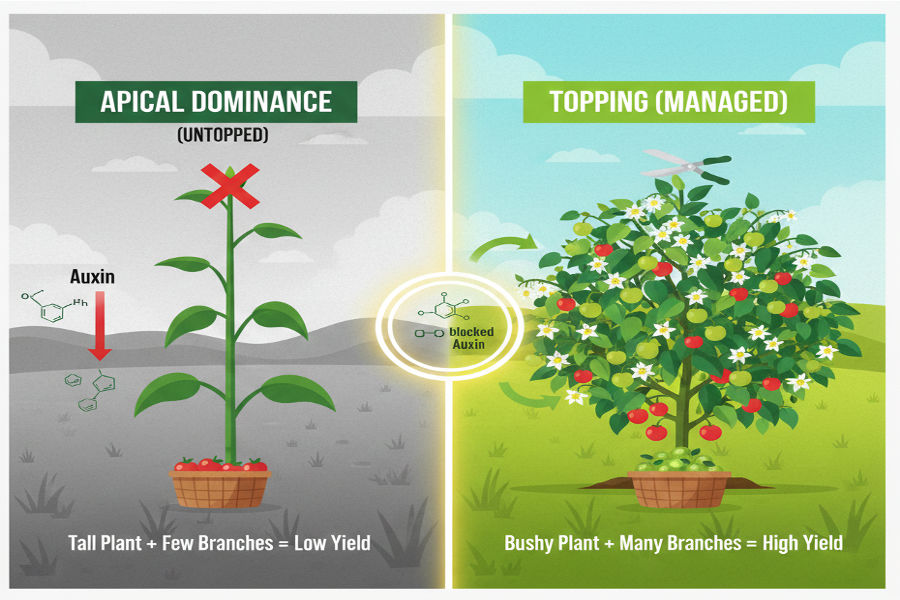
Apical Dominance – Increasing Yield Through Lateral Branch Development
In agriculture, improving crop yield is not only dependent on fertilizers and irrigation but also on understanding plant growth behavior. One of the key physiological concepts influencing plant architecture and yield is Apical Dominance.
What is Apical Dominance?
Apical dominance is a condition in which the main stem of a plant grows strongly while the growth of lateral branches is suppressed. The apical or terminal bud controls the overall growth pattern of the plant.
Scientific Basis of Apical Dominance
The primary factor responsible for apical dominance is the plant hormone Auxin. Auxin is produced in the apical bud and moves downward, inhibiting the development of lateral buds. As a result, the plant grows taller with fewer branches.
Relationship Between Apical Dominance and Yield
In crops such as pigeon pea, chickpea, and cotton, yield is directly related to the number of branches. More branches lead to more flowers, pods, and bolls. Therefore, managing apical dominance is essential for higher productivity.
Importance of Topping or Pinching
Removing the apical bud at the right growth stage reduces the effect of auxin and activates lateral buds. This results in bushy plant growth, better light utilization, uniform nutrient distribution, and a significant increase in yield.
Management Practices
In large-scale farming, mechanical topping, proper plant spacing, balanced nitrogen management, and the use of biostimulants are effective practices. Understanding and managing apical dominance helps in developing yield-efficient crops rather than just tall plants.

