


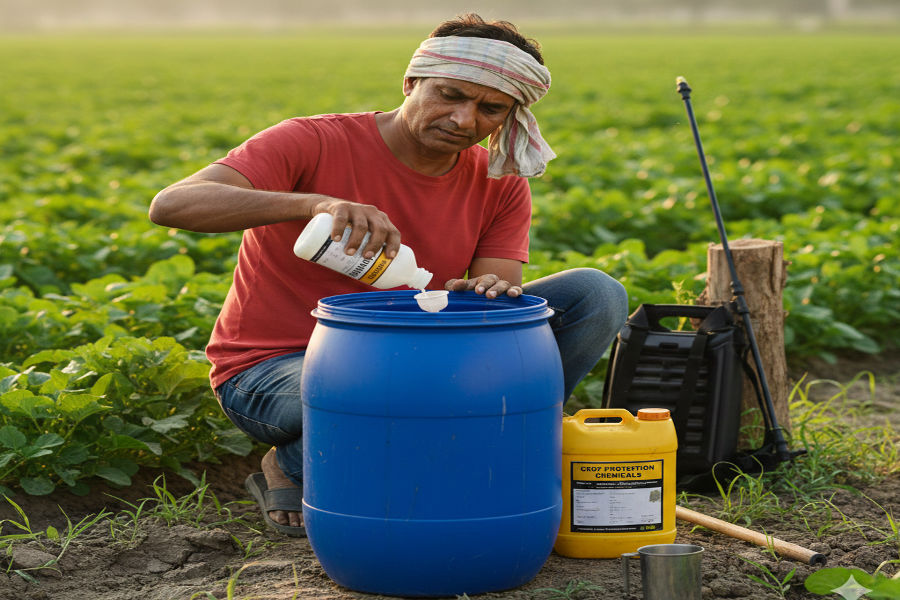
7 Golden Rules for Successful Crop Spraying
Crop spraying is one of the most important processes in agriculture. Even if the chemicals are of the best quality, incorrect spraying techniques fail to deliver expected results. Therefore, every farmer must understand and follow the following 7 golden rules for effective spraying.
1) Select the Right Chemical
Choose fertilizers or crop protection chemicals based on the crop stage, type of pest or disease, and nutrient requirements. Avoid spraying based on assumptions or neighbor’s advice.
2) Check Water Quality
Hard or dirty water reduces the performance of chemicals. In such cases, using a suitable adjuvant or water conditioner becomes essential.
3) Use the Right Adjuvant
Adjuvants play a crucial role in improving spray performance. Non-ionic adjuvants are considered safe for nutrition and systemic chemicals, while anionic adjuvants can be used for contact action.
4) Follow the Recommended Dose
Higher dose does not mean better results. Overdosing may cause leaf burn, fruit drop, and yield reduction. Always follow the recommended label dose.
5) Choose the Right Spraying Time
Spray early in the morning or late in the evening. Avoid spraying during strong sunlight, high wind or just before rain.
6) Maintain Proper Spraying Technique
Spray droplets should be fine, and the chemical must reach both sides of the leaves. Apply only till the crop surface becomes uniformly moist.
7) Monitor the Crop After Spraying
Observe the crop for 2 to 3 days after spraying. If any adverse effects are noticed, stop further spraying until the issue is resolved.
Conclusion
Spraying is not just an application of chemicals; it is a scientific operation. Right chemical + right adjuvant + right timing = successful spraying. Correct spraying practices help achieve higher yields at lower cost.

