


5 Key Criteria for Identifying Quality Organic Fertilizer
The market today offers dozens of organic fertilizer brands, but the word "organic" on a bag doesn't guarantee consistent quality. Some fertilizers show results as soon as they're applied, while others make no visible difference for months. The real difference lies in the fertilizer's internal composition, its processing, and how much nourishment it provides to the microorganisms in the soil.
In this blog, we'll look at exactly what to check when choosing an organic fertilizer, so that neither your money nor your effort goes to waste.
Carbon:Nitrogen Ratio — Why It Should Be Below 20
The most reliable way to judge the quality of an organic fertilizer is to check its C:N ratio (Carbon-to-Nitrogen ratio).
Why does this ratio matter?
When fertilizer is mixed into soil, soil microorganisms break it down. This decomposition process requires both carbon (for energy) and nitrogen (for building microbial cells).
● If the C:N ratio is above 20, microorganisms pull available nitrogen straight out of the soil to meet their own needs — this is called nitrogen immobilization. As a result, the crop is left short of nitrogen and growth slows down.
● If the ratio is below 20, decomposition happens faster and nitrogen becomes available to the crop almost immediately.
What to check in practice:
● Check whether the C:N ratio is mentioned on the packaging or in a lab report.
● If it isn't, ask the seller for a lab test report — quality manufacturers provide this readily.
● Raw manure or partially decomposed organic matter usually has a high C:N ratio, so it's best avoided.
Mushroom-Based Organic Manure — An Alternative Source
Beyond traditional manure or compost, Spent Mushroom Substrate (SMS) — the byproduct left over from mushroom cultivation — is an excellent and lesser-known alternative.
How is it produced?
The substrate used in mushroom farming (typically a mix of straw, husk, and bran) is left over once the mushrooms are harvested. Because this substrate has already gone through a fungal process, it naturally contains large amounts of beneficial microorganisms and enzymes.
Benefits:
● Being already partially decomposed, it becomes available to crops quickly once added to soil.
● The natural fungal network helps improve soil structure.
● It's often cheaper than regular compost, since it's a byproduct of the mushroom industry.
● It improves the soil's water retention capacity.
When buying, ask how old the SMS is and whether it has been properly stabilized — using fresh SMS can cause a temporary nitrogen shortage.
The Solution — Origino as an Example (N-P-K Balance, Microbial Activity)
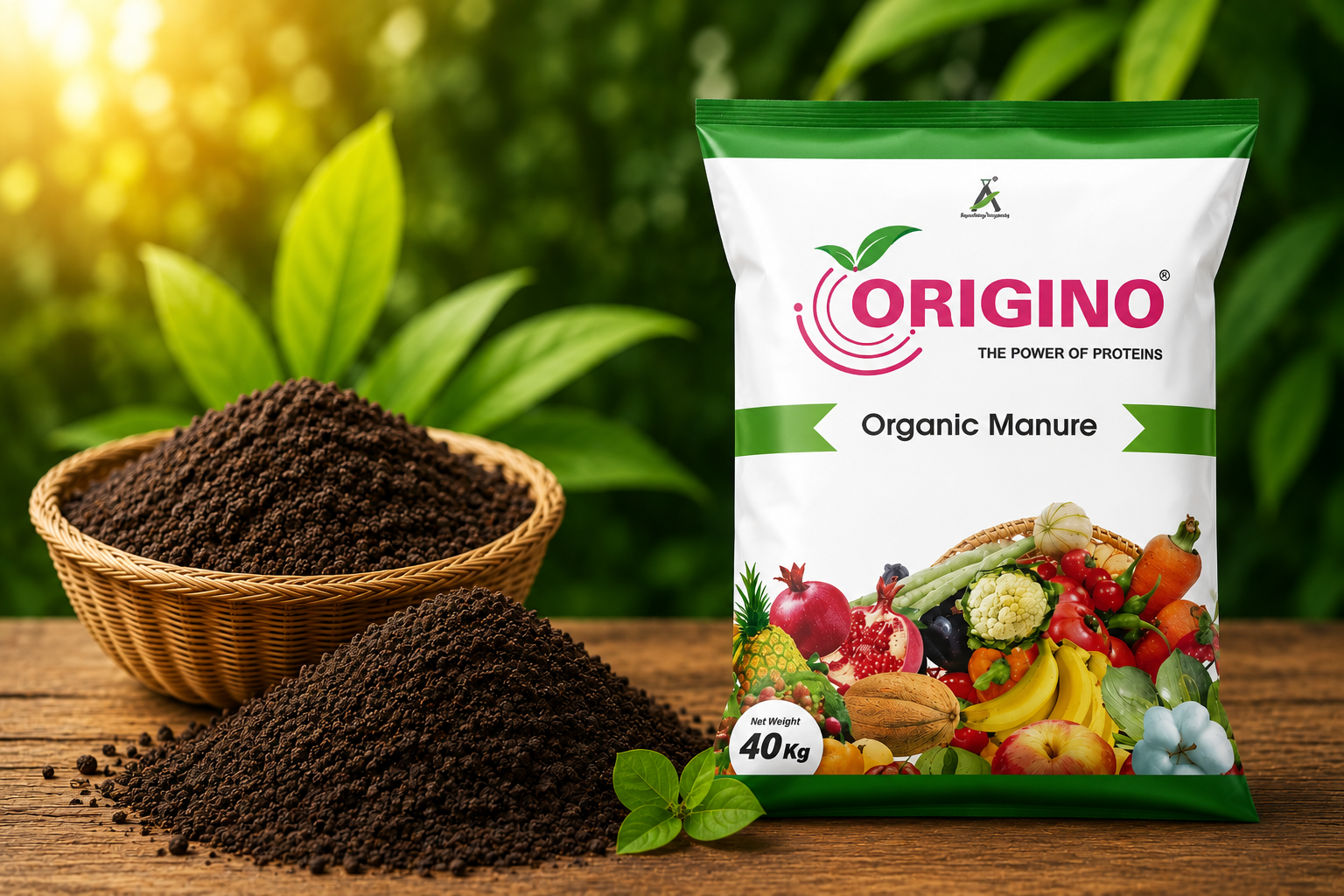
An example that brings both of the above criteria together — a proper C:N ratio and the use of mushroom-based components — is the organic fertilizer Origino.
What to look for in Origino:
● Balanced N-P-K ratio: nitrogen, phosphorus, and potash levels are kept balanced according to crop needs.
● Active microbial content: beneficial bacteria and fungi speed up the breakdown of organic matter in the soil.
● Low C:N ratio: this avoids the risk of nitrogen immobilization and shows results quickly.
● Improved water retention: soil structure improves, helping crops hold up even with less water.
When choosing a fertilizer of this kind, it's wise not to stop at the word "organic" — checking the technical criteria above is what actually matters.
Frequently Asked Questions (FAQ)
1. What's the difference between organic fertilizer and a biofertilizer?
Organic fertilizer is made from materials of animal or plant origin and directly supplies organic matter and nutrients to the soil. A biofertilizer, on the other hand, is a mixture of living microorganisms that doesn't supply nutrients itself — instead, it makes nutrients already present in the soil or air available to the crop (for example, nitrogen-fixing bacteria). Using both together often gives the best results.
2. How does water retention capacity improve?
The humus and microorganisms present in organic matter bind soil particles together, creating a porous structure. This structure increases the soil's capacity to hold water and slows runoff. Organic matter also absorbs and holds water itself, like a sponge, keeping roots moist even in dry weather and reducing overall water needs.

