


How water is taken up by plants and transported to the top parts ?
Water is one of the most essential components for plant growth and survival. It plays a key role in nutrient transport, photosynthesis, and maintaining plant structure. Understanding how water moves from the soil to the top parts of a plant is important for farmers, gardeners, and anyone involved in agriculture.
What is water uptake in plants
Water uptake is the process through which plants absorb water from the soil through their roots. This absorbed water is then transported to different parts of the plant, including stems, leaves, flowers, and fruits. This process ensures that the plant remains healthy and functions properly.
Absorption of water by roots
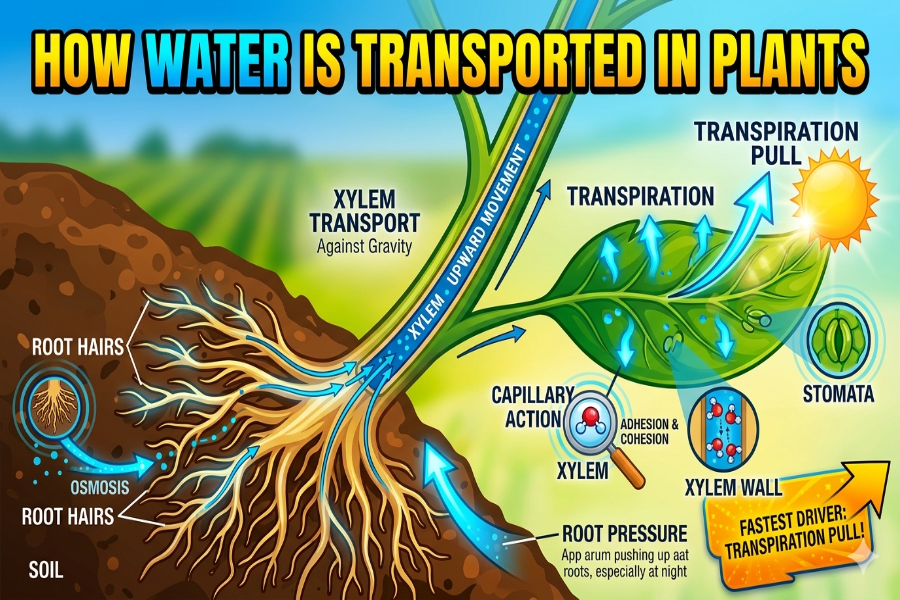
The process begins in the roots. Plants have tiny hair-like structures called root hairs, which increase the surface area for water absorption. Water enters the root cells mainly through osmosis, where water moves from an area of higher concentration in the soil to a lower concentration inside the root cells.
Movement of water through root tissues
After entering the root hairs, water moves through various layers of root cells until it reaches the xylem. The xylem is a specialized vascular tissue responsible for transporting water and minerals from the roots to the upper parts of the plant.
Transport of water through xylem
Water travels upward through the xylem vessels from the roots to the stem and leaves. This upward movement happens against gravity and is made possible by a combination of forces working together within the plant.
Role of transpiration pull
Transpiration is the process in which water evaporates from the surface of leaves through small openings called stomata. This evaporation creates a negative pressure or suction force that pulls water upward from the roots to the leaves. This force is known as transpiration pull and is the main driving factor in water transport.
Other forces involved in water movement
In addition to transpiration pull, two other forces support water movement in plants. Root pressure helps push water upward from the roots, especially during the night. Capillary action allows water to move through the narrow xylem vessels due to adhesion and cohesion forces between water molecules and plant walls.
Importance of water transport in plants
Water transport is essential for carrying nutrients from the soil to different parts of the plant. It helps maintain cell structure by keeping cells firm and supports photosynthesis by supplying necessary water to leaves. It also helps regulate plant temperature through the process of transpiration.
Factors affecting water uptake
Several environmental and soil factors influence water uptake in plants. These include soil moisture levels, temperature, humidity, wind, and soil type. Proper management of these factors can improve water efficiency and crop productivity.
Practical tips for better water uptake
Farmers can improve water uptake in crops by maintaining proper irrigation practices and avoiding both drought and waterlogging conditions. Adding organic matter to soil improves water retention. Mulching helps reduce evaporation losses. Selecting suitable crop varieties and maintaining healthy soil conditions also play a crucial role.
Conclusion
The movement of water from roots to the top parts of plants is a well-coordinated process mainly driven by transpiration pull, supported by root pressure and capillary action. Understanding this process can help improve crop management practices, leading to better growth and higher yields.

