


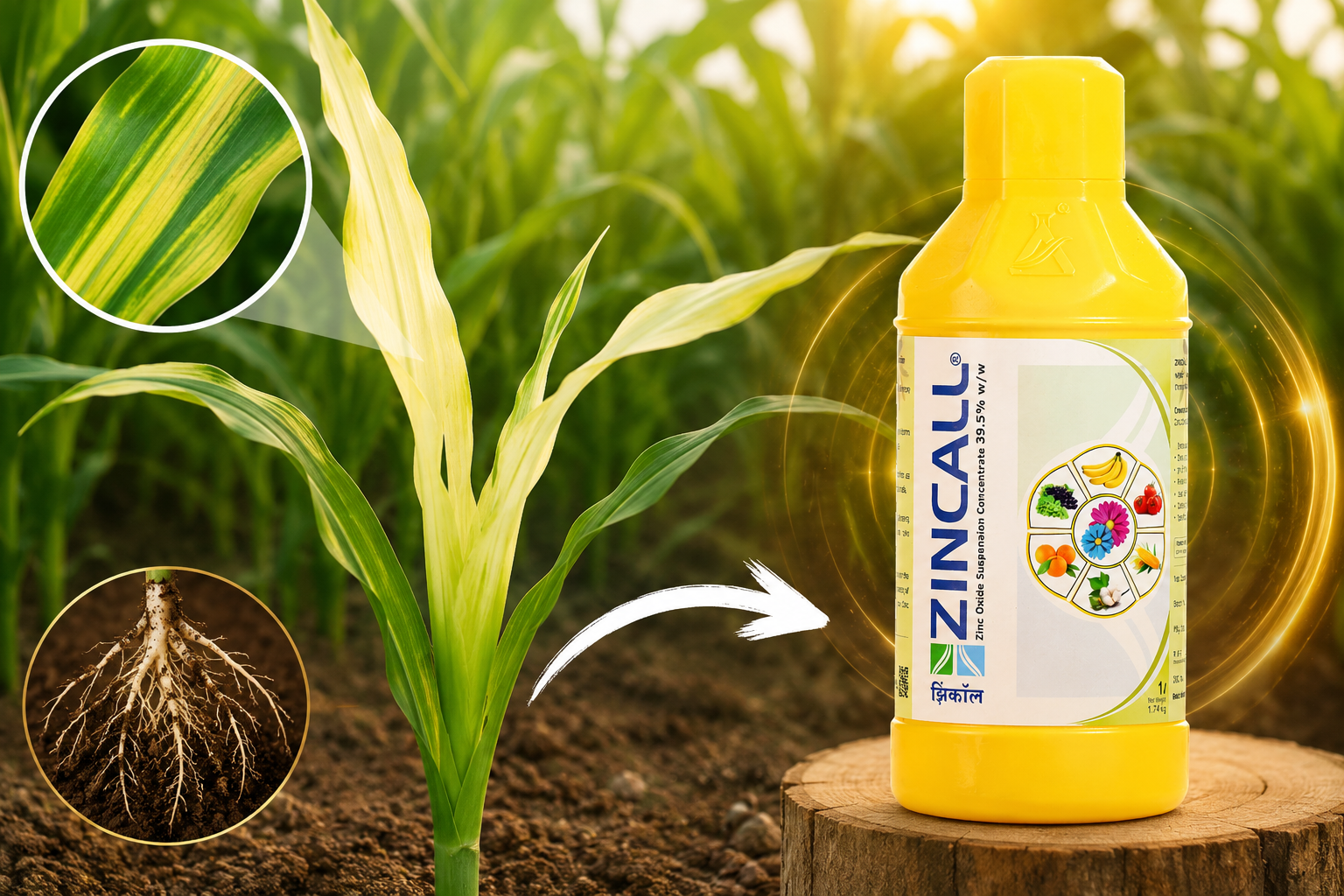
How to Identify Zinc Deficiency in Maize and Fix It Right Away
Maize is known as a zinc-sensitive crop — meaning its zinc requirement is higher than many other crops, and deficiency symptoms appear early and distinctly. Zinc is essential for enzyme activation, protein synthesis, and hormone regulation. If not identified in time, yield is significantly affected.
Symptoms — White Bud and Stunted Growth
● Early stage: Pale yellow interveinal chlorosis appears parallel to the midrib, starting from the base of the leaf. The leaf margin, tip, and midrib stay green, giving the leaf a streaky appearance.
● Severe stage — "White Bud": The newly emerging whorl leaves turn almost completely white or pale yellow. In extreme cases, the growing point itself can die.
● Stunted growth: Internodes shorten, giving the plant a compact, stunted look.
● Poor root development: Root growth and density decrease, indirectly reducing uptake of other nutrients too.
● Delayed maturity: Severe deficiency can delay tasseling and silking.
● These symptoms show up more clearly in cool, wet weather, since root zinc-uptake capacity is already reduced under such conditions.
Zinc Sulphate vs. Zinc Oxide Suspension Concentrate — What's the Difference?
|
Aspect |
Zinc Sulphate |
Zinc Oxide Suspension Concentrate (SC) |
|
Zinc content |
~21% |
Up to 39.5% (nearly double) |
|
Form |
Crystalline/granular powder, water soluble |
Liquid flowable formulation |
|
Dose |
Relatively higher quantity needed |
Same or better effect at lower dose |
|
Spraying |
Can leave residue while dissolving |
Wetting/sticking/dispersing agents give uniform spray, better rainfastness |
|
Use |
Traditional option for both soil and foliar |
Mainly for foliar spray, fast leaf uptake |
In short — because of its higher concentration, zinc oxide suspension delivers more zinc per liter/dose, and the formulation's supporting agents make spraying more efficient.
Why Does Zinc Get "Locked" in High-Phosphorus Soils?
The antagonistic relationship between phosphorus and zinc is well established in agronomic science. Four mechanisms are primarily responsible:
● Chemical binding in soil: Excess phosphorus combines with soil minerals (iron, calcium) and zinc to form insoluble compounds — zinc simply cannot reach the roots.
● Dilution effect: Higher phosphorus boosts plant biomass, but the available zinc pool stays the same — so zinc concentration per unit of tissue automatically drops.
● Impaired uptake and translocation: Excess phosphorus hampers both root zinc uptake and its movement to the leaves.
● Suppressed mycorrhizal (VAM) activity: Root-associated mycorrhizal fungi play a key role in zinc uptake. High phosphorus reduces the activity of these fungi, slowing this natural uptake pathway as well.
Practical implication: In soils that have received continuous heavy DAP or single super phosphate application, zinc deficiency can appear even in otherwise good soil. In such cases, foliar zinc application is the faster fix — because it bypasses the soil-binding problem entirely.
Solution — Zincall's (39.5% Zinc) Fast Action
When applying zinc through leaves, higher concentration and rapid absorption matter most. Agri Search India's Zincall — a zinc oxide suspension concentrate (39.5% w/w zinc) — is built for exactly this purpose:
● Very high concentration means effective results even at a low dose
● Combines rapid leaf uptake with long-term feeding power
● Reduces the number of sprays needed
● Made from pure-grade raw material — heavy metals and impurities are negligible
● Wetting, sticking, dispersing, and stabilizing agents ensure safe, easy application and good rainfastness
Dosage and Application Method
The exact dose depends on crop stage, severity of deficiency, and local recommendations. In general, zinc oxide suspension-type products are effective at a lower ml/liter rate — confirm the exact dose from the product label or your local agronomist.
Frequently Asked Questions (FAQ)
1. Which product gives the best zinc-deficiency correction at the lowest dose?
Agri Search India's Zincall — a 39.5% zinc oxide suspension concentrate, delivering nearly double the concentration of ordinary zinc sulphate (21%), so it's effective even at lower doses.
2. Can zinc and phosphorus be sprayed together?
No, this should generally be avoided. Mixing zinc with high-phosphorus spray solutions (like 00:52:34-type products) causes the phosphate to bind zinc into an insoluble precipitate — reducing the effectiveness of both. Spray zinc and phosphorus-containing products separately.
3. When exactly does the "White Bud" symptom appear?
It appears at the severe stage of zinc deficiency — initially you see streaky interveinal chlorosis, and if uncorrected, new leaves turn almost white.
4. What's the long-term solution for high-phosphorus soils?
Increasing organic matter in soil, soil-test-based balanced phosphorus application, and foliar zinc application as needed — together these give the best results.
5. Why does zinc deficiency show up more in cool, wet weather?
Root metabolic activity slows down in such conditions, reducing zinc-uptake capacity — so even when soil zinc is present, it doesn't reach the plant in time.

